Showing posts with label PML. Show all posts

Thursday, 17 November 2011

Pervez Musharraf

Pervez Musharraf

APML

 
Perves Musharraf
History Of Pervez Musharraf
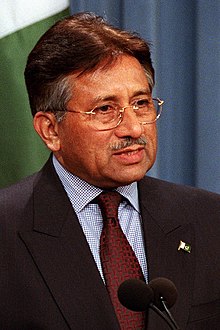
Pervez Musharraf (Urdu: پرویز مشرف, born 11 August 1943), is a retired four-star general who served as the 13th Chief of Army Staff and 10th President of Pakistan as well as 10th Chairman of the Joint Chiefs of Staff Committee. Musharraf headed and led an administrative military government from October 1999 till August 2007. He ruled Pakistan as Chief Executive from 1999–2001 and as President from 2001-08. In the face of impeachment, he resigned on 18 August 2008.
After years of military service, he rose to prominence when Prime Minister Nawaz Sharif appointed him as the Chief of Army Staff in October 1998. Musharraf was the mastermind behind the controversial and internationally condemned Kargil infiltration, which derailed peace negotiations with Pakistan's long standing enemy India. He previously also played a vital role in the Afghanistan civil war (1996-2001) where he sent thousands of young Pakistan Army and paramilitary staff to waste their blood in the war against the Northern Alliance. After months of contentious relations with Sharif, Musharraf took power through a bloodless military coup, and placed him in under an unconstitutional house-arrest, later shifting him to Adiala Jail.
As Pakistan's head of state, he was a U.S. ally in the War on Terror. He was credited with the development of Pakistan's economy during the early years of his rule. however, later during his 8 year reign, he is blamed for leadig Pakistan towards the worst energy and sugar crises in her history. His limited popularity suffered after his suspension of the Supreme Court Chief Justice and the Lal Masjid siege. His attempt to institute emergency rule failed as calls for his impeachment escalated. The return of Benazir Bhutto and Nawaz Sharif from exile fast-tracked the nation towards parliamentary democracy ending Musharraf's reign.
In February 2011, a Pakistani court issued an arrest warrant for him because of his alleged involvement in the assassination of Benazir Bhutto. As of June 2011, he lives in self-exile in London but has vowed to return for the next election. He has announced that he intends to return to Pakistan on 23 March 2012.

Chairman Joint Chiefs of Staff

In October 1998, General was forced to resign as Chief of Army of Staff for advocating the creation of a National Security Council with an active military role.[18] Prime minister Sharif saw this suggestion as General Karamat's involvement in politics, therefore Sharif forced General Karamat to resigned.[18] Prime Minister Nawaz Sharif personally promoted as Musharraf as four-star general to replace Karamat.[18] Musharraf superseded Lieutenant General Khalid Nawaz Khan and Lieutenant-General Ali Kuli Khan Khattak who were much senior, in merit, to General Musharraf. General Ali Kuli Khan Khattak was a highly competent officer who held most of the prestigious assignments in the Army, and belonged to respected Muhajir family.[23] Later, Sharif promoted General Musharraf to another and most prestigious four-star assignment in the Pakistan Armed Forces, the Chairman of the Joint Chiefs of Staff Committee when Musharraf insisted Sharif.[23] Admiral Fasih Bokhari, who was much senior to Musharraf on both merit and experience, resigned in protest when General Musharraf superseded the Admiral.[23] According to Abdul Qadeer Khan, Sharif's promotion awarded to Musharraf was illegal as he was unqualified and incompetent and it was the biggest blunder and unforgettable mistake made by Nawaz Sharif.[23]

 Kargil Conflict

The Pakistan Army originally conceived the Kargil plan after the Siachen conflict but the plan was rebuffed repeatedly by senior civilian and military officials.[22] Musharraf was a leading strategist behind the Kargil Conflict.[12] From March–May 1999, he ordered the secret infiltration of Kashmiri forces in the Kargil district.[20] After India discovered the infiltration, a fierce Indian offensive nearly lead to a full-scale war.[20][22] However, Sharif withdrew support of the insurgents in the border conflict in July because of heightened international pressure.[20] Sharif's decision antagonized the Pakistan Army and rumors of a possible coup began emerging soon afterward.[20][24] Sharif and Musharraf dispute on who was responsible for the Kargil conflict and Pakistan's withdrawal.[25]

1999 coup

Military officials from Musharraf's Joint Chief of Staff met with regional corps commanders three times in late September in anticipation of a possible coup.[26] To quiet rumors of a fallout between Musharraf and Sharif, Sharif officially certified Musharraf's remaining two years of his term on September 30.[26][27]
Musharraf had left for a weekend trip to take part in Sri Lanka's Army's 50th-anniversary celebrations.[28] After hearing news of his possible sacking, Musharraf rushed on Pakistan International Airlines flight from Colombo to Karachi on October 12.[29] The military had already begun to mobilize troops towards Islamabad from nearby Rawalpindi.[29] Sharif formally declared Inter-Services Intelligence (ISI) Director Khwaja Ziauddin to replace Musharraf as Army Chief on national television at the Aiwan-e-Sadr presidential palace.[28][29] The military placed Sharif under house arrest,[30][30] but in a last ditch effort Sharif privately ordered Karachi air traffic controllers to redirect Musharraf's flight to Nawabshah where Sharif's own security team were ready to put Musharraf in custody.[26][29] The plan failed after soldiers in Karachi surrounded the airport control tower.[29][31] At 2:50 AM on October 13,[30] Musharraf addressed the nation with a pre-recorded message.[29]
Musharraf met with President Rafiq Tarar on October 13 to deliberate on legitimizing the coup.[32] On October 15, Musharraf ended emerging hopes of a quick transition to democracy after he declared state of emergency, suspended the Constitution, and assumed power as Chief Executive.[31][33] He also quickly purged the government of political enemies, notably Ziauddin and national airline chief Shahid Khaqan Abbassi.[31] On October 17, he gave his second national address and established a seven-member military-civilian council to govern the country.[34][35] He named three retired military officers and a judge as provincial administrators on October 21.[36]
There were no organized protests within the country to the coup.[35][37] The coup was widely criticized by the international community.[38] Consequently, Pakistan was suspended from the Commonwealth of Nations.[39][40] Sharif was put under house arrest and later exiled to Saudi Arabia.[41]

First days

Musharraf's first foreign visit was to Saudi Arabia on October 26 where he met with King Fahd.[42][43] After meeting senior Saudi royals, the next day he went to Medina and performed Umrah in Mecca.[42] On October 28, he went to United Arab Emirates before returning home.[42][43]
By the end of October, Musharraf appointed many technocrats and bureaucrats in his Cabinet, including former Citibank executive Shaukat Aziz as Finance Minister and Abdul Sattar as Foreign Minister.[44][45] In early November, he released details of his assets to the public.[46]
In late December 1999, Musharraf's dealt with his first international crisis when India accused Pakistan's involvement in the Indian Airlines Flight 814 hijacking.[47][48] Though United States President Bill Clinton pressured Musharraf to ban the alleged group behind the hijacking — Harkat-ul-Mujahideen,[49] Pakistani officials refused because of fears of reprisal from political parties such as Jamaat-e-Islami.[50]
In March 2000, Musharraf banned political rallies.[37]

Sharif trial and exile

The army held Sharif under house arrest at a government guesthouse[51] and opened his Lahore home to the public in late October 1999.[44] He was formally indicted in November[51] on charges of hijacking, kidnapping, attempted murder, and treason for preventing Musharraf's flight from landing at Karachi airport on the day of the coup.[52][53] His trial began in early March 2000 in an anti-terrorism court,[54] which are designed for speedy trials.[55] He testified Musharraf began preparations of a coup after the Kargil conflict.[54] Sharif was placed in Adiala Jail, infamous for hosting Zulfikar Ali Bhutto's trial, and his leading defense lawyer, Iqbal Raad, was shot dead in Karachi in mid-March.[56] Sharif's defense team blamed the military for intentionally providing their lawyers with inadequate protection.[56] The court proceedings were widely accused of being a show trial.[57][58][59] Sources from Pakistan claimed that Musharraf and his military government's officers were in full mood to exercise tough conditions on Sharif, was intended to sent Navaz Sharif to gallows to face similar fate as Zulfikar Ali Bhutto in 1979. It was the pressure on Musharraf exerted by Saudia Arabia and the United States to exile Sharif after it became authenticated that the court is near to place her verdict on Navaz Sharif on his charges, and the court will sentenced Sharif to death. Sharif signed an agreement with Musharraf and his military government and his family was exiled to Saudi Arabia in December 2000.

Constitutional changes

Shortly after Musharraf's takeover, he issued The Oath of Judges Order 2000, which required judges to take a fresh oath of office swearing allegiance to military. On 12 May 2000, the Supreme Court asked Musharraf to hold national elections by 12 October 2002. The residing President Rafiq Tarar remained in office until June 2001. Musharraf formally appointed himself President on 20 June 2001. In August 2002, he issued the Legal Framework Order, which added numerous amendments to the 1973 Constitution. In October 2002, Pakistan held elections which the pro-Musharraf PML-Q won wide margins. The PML-Q and MQM formed a coalition and legitimized Musharraf's rule.

Relations with India

After the 2001 Gujarat earthquake, Musharraf expressed his sympathies to Indian Prime Minister Atal Bihari Vajpayee and sent a plane load of relief supplies to India.[69][70][71]
In the mid-2004, Musharraf began a series of talks with India to resolve the Kashmir dispute.

[edit] Relations with Saudi Arabia

In 2006, King Abdullah visited Pakistan for the first time as King. Musharraf honored King Abdullah with the Nishan-e-Pakistan.[72] Musharraf received the King Abdul-Aziz Medallion in 2007.[73]

[edit] Nuclear scandals

In 2001, as part of Musharraf's de-extremism policies, the Federal Investigation Agency (FIA) apprehended Sultan Bashiruddin Mahmood, a nuclear engineer, and Dr. Chaudhry Abdul Majeed, a nuclear chemist, in suspicion of having contacts and connections to Taliban. During this sting operation, it was revealed that Mahmood had a meeting with Osama bin Laden to build a radiological weapon. But, Mahmood was not capable of developing the weapon as he was an expert in nuclear power technology, not weapons. Therefore, Al-Qaeda was unable to gain any knowledge from these scientists, the ISI and CIA later reported. Musharraf, who during this time was Chairman of Joint Chiefs of Staff Committee, decided to militarily debriefed the scientists. Mahmood and Dr. Majeed were taken into the custody of the Judge Advocate General Branch (JAG) where the debriefings continued until the early 2005. After the debriefings were completed, both scientists were put out of public eye and were prevented from attending any science seminars held in the country.
As President, General Musharraf had promoted Dr. Abdul Qadeer Khan to the most prestigious post, the Science Advisor to the President. Dr. Abdul Qadeer Khan's open-promotion of nuclear weapons and ballistics missiles brought an international embarrassment for Pakistan. According to Zahid Malik, after the government received potential and solid evidence against Khan from the United States, General Musharraf and the military establishment were in full mood to exercise rough actions against Khan. Khan's debriefing was necessary for General Musharraf to prove the loyalty of Pakistan to the United States and Western world.
One of the most widely-reported controversies during Musharraf's administration arose as a consequence of the disclosure of nuclear proliferation by Dr. A.Q. Khan, a national hero and one of the most decorated scientists. Initially General Musharraf denied knowledge of or participation by Pakistan or the Pakistan Army, Pakistan Air Force and even the Pakistan Navy, despite Khan urging that Musharraf was the leader of the proliferation ring. On January 2004, General Musharraf dismissed Dr. A.Q. Khan as his Science Adviser. A formal military debriefing of Khan continued for the next three years.
Musharraf faced bitter domestic criticism for singularly attempting to vilify Khan. Musharraf's long standing ally MQM gave a cold shoulder and bitter and acrimonious criticism to Musharraf over his handling of Khan. MQM tapped an anti-Musharraf movement for the release of Khan which initially shocked Musharraf and the United States. MQM and her leaders threatened to leave hMusharraf's government if Khan was persecuted or even jailed. Fearing his regime would be topple if MQM continued to tap this wave, Khan was pardoned in exchange for cooperation in the investigation by Musharraf, but was put under house arrest where he was forced to attend various debriefings which would continued for hours.[74] After Musharraf's resignation, Dr. Khan was finally released from house arrest by the executive order of the Supreme Court of Pakistan. After Musharraf departed from the country, then-Chairman of the Joint Chiefs of Staff Committee General Tärikue Majid ended further debriefings of Dr. Khan.
 Musharraf With USA President

Suspension and reinstatement of the Chief Justice

On 9 March 2007, Musharraf suspended Chief Justice Iftikhar Muhammad Chaudhry and pressed corruption charges against him. He replaced him with ally Acting Chief Justice Javed Iqbal.
Musharraf's moves sparked protests among Pakistani lawyers. On 12 March 2007, lawyers started a campaign called Judicial Activism across Pakistan and began boycotting all court procedures in protest against the suspension. In Islamabad, as well as other cities such as Lahore, Karachi, and Quetta hundreds of lawyers dressed in black suits attended rallies, condemning the suspension as unconstitutional. Slowly the expressions of support for the ousted Chief Justice gathered momentum and by May, protesters and opposition parties took out huge rallies against Musharraf and his tenure as army chief was also challenged in the courts.

Lal Masjid siege

Lal Masjid had a religious school for women and the Jamia Hafsa madrassa, which was attached to the mosque. A male madrassa was only a few minutes drive away. The mosque often attended by prominent politicians including prime ministers, army chiefs, and presidents.
The Lal Masjid administration had been in an escalating conflict with government authorities since January 2007. Government officials accused the mosque leadership of organizing a vigilante "vice-squad" which conducted raids against brothels, kidnappings of corrupt police officers, and suspected prostitutes. In April 2007, the mosque administration set up its own Islamic court in violation of government sanctions. In July 2007, a confrontation occurred when government authorities sent officers for demolition of the mosque under the pretense that it was created illegally.
This development led to a standoff between police forces and students (mostly female). Mosque leaders and students refused to leave the mosque and the children's library. They remained within the mosque to prevent the demolition. The situation was only defused after the authorities backed down and offered talks.
But government forces did not back down. Pakistani troops stormed the building which led to a bloody siege that ended with the deaths of more than 100 people.

Return of Benazir Bhutto and Nawaz Sharif

Also on 8 August 2007, Benazir Bhutto spoke about her secret meeting with Musharraf on 27 July, in an interview on the Canadian Broadcasting Corporation.
On 14 September 2007, Deputy Information Minister Tariq Azim stated that Bhutto won't be deported, but must face corruption suits against her. He clarified Sharif's and Bhutto's right to return to Pakistan. Bhutto returned from eight years exile on 18 October. On 17 September 2007, Bhutto accused Musharraf's allies of pushing Pakistan to crisis by refusal to restore democracy and share power. Musharraf called for a three day mourning period after Bhutto's assassination on 27 December 2007.
Sharif returned to Pakistan in September 2007, and was immediately arrested and taken into custody at the airport. He was sent back to Saudi Arabia.Saudi intelligence chief Muqrin bin Abdul-Aziz Al Saud and Lebanese politician Saad Hariri arrived separately in Islamabad on 8 September 2007, the former with a message from Saudi King Abdullah and the latter after a meeting with Nawaz Sharif in London. After meeting President General Pervez Musharraf for two-and-a-half hours discussing Nawaz Sharif's possible return. On arrival in Saudi Arabia, Nawaz Sharif was received by Prince Muqrin bin Abdul-Aziz, the Saudi intelligence chief, who had met Musharraf in Islamabad the previous day. That meeting had been followed by a rare press conference, at which he had warned that Sharif should not violate the terms of King Abdullah's agreement of staying out of politics for 10 years.

Resignation from the Army

On 2 October 2007, Musharraf named Lt. Gen. Ashfaq Kayani as vice chief of the army starting 8 October. When Musharraf resigned from military on 28 November 2007, Kayani became Chief of Army Staff.

2007 Elections

In a March 2007 interview, Musharraf said that he intended to stay in the office for another five years.
A nine-member panel of Supreme Court judges deliberated on six petitions (including Jamaat-e-Islami's, Pakistan's largest Islamic group) for disqualification of Musharraf as presidential candidate. Bhutto stated that her party may join other opposition groups, including Sharif's.
On 28 September 2007, in a 6–3 vote, Judge Rana Bhagwandas's court removed obstacles to Musharraf's election bid.
Perves Musharraf Imposed Emergency
Pervez Musharraf

Pervez Musharraf In Uniform
Pervez Musharraf Dogs

Pervez Musharraf

Ghulam Mujtaba

Ghulam Mujtaba
APML
Ghulam Mujtaba
History of Ghulam Mujtaba
Golam Mujtaba,[6], (Urdu: غلام مجتبی) (born on 16 December 1955 in Karachi, Pakistan) is a prominent politician of urban Sindh [7] in Pakistan[3] [8]. He served as Provincial Advisor Sindh,[9], Pakistan (1992–94).[4] He was the leader of the coalition party to the Sindh Government from 1992-94[5][10]. Dr. Mujtaba was a prominent student leader of Pakistan (1976–78). He was elected General Secretary of the Karachi University Students Union in 1976, and served as a member of the University Senate and Syndicate in 1976-78.[6][11].
  • Dr. Gholam Mujtaba is the Central Vice President of the All Pakistan Muslim League. [14]
  • Member Presidents Circle American Security Council Foundation, USA [15].
  • Member Chairman’s Advisory Board Republican Party of the United States [16].
  • Director Corona-Elmhurst Center for Economic Development, New York [17].
  • Chairman, Pakistan Graduates Forum, Pakistan [18].

Political Career (Past)

  • Member President’s Victory Team, Republican Party USA (2000-08)[19].
  • Advisor to Chief Minister Sindh, Pakistan (1993)[20].
  • Chief Organizer, National Peoples Party Overseas. (1988-92)[21].
  • President Pharmacy Teachers Association of Pakistan (1987-88)[22].
  • General Secretary Karachi University Students Union (1976-78)[23].
  • Member Karachi University Syndicate & Senate (1976-78)[24].
  • Chairman Literary & Debating Society Karachi University Students Union (1975).
  • Faculty Representative Karachi University Students Union (1975)[25].

Ghulam Mujtaba
APML

Saturday, 12 November 2011

Nawaz Sharif

Nawaz Sharif
PML(N)

History Of Nawaz Sharif
Mian Mohammad Nawaz Sharif (Punjabi, Urdu: میاں محمد نواز شریف; born 25 December 1949) is a Pakistani conservative politician and steel magnate who served as 12th Prime Minister of Pakistan in two non-consecutive terms from November 1990 to July 1993, and from February 1997 to October 12, 1999. He is the current and incumbent President of the Pakistan Muslim League-N, an ideologically Islamism political force in Pakistan.
Before becoming the Prime minister, Sharif served as the 9th Chief Minister of Punjab Province from 1985 to 1990 and embarked his political career under the military regime of President General Zia-ul-Haq. A businessman and lawyer by profession, he owns Ittefaq Group, a private steel mill enterprise and one of the largest producer of iron materials. Sharif is noted as being as Pakistan's one of the wealthiest investor in Steel mill business and a conservative politician advocating for the conservatism in the country, and capitalism as its economic base. His first term was shortened after President Ghulam Ishaq Khan dismissed his government citing " corruption and nepotism" allegation.
From 1993 until 1996, Sharif served as the Leader of the Opposition in the socialist democratic government of Benazir Bhutto. In 1997, he was elected on for a second term by an overwhelming margin after brutally defeating Benazir Bhutto whose government was dismissed on corruption became known in public. During his second term, he notably ordered Pakistan's first nuclear tests in response to India's nuclear tests, as part of his tit-for-tat policy, a termed he coined after the tests.Sharif controversially appointed Pervez Musharraf— a lieutenant-general and commander of the I Strike Corps— as the Chief of Army Staff and promoted him to the 4 star rank. Sharif later violated the code of conduct of Pakistan Armed Forces when he controversially appointed General Pervez Musharraf as the Chairman of the Joint Chiefs of Staff Committee. His decision forced Chief of Naval Staff Admiral Fasih Bokhari to resign from the Navy.
Despite Sharif giving prestigious appointments to General Musharraf and the Army, Sharif developed serious disagreements pertaining to the undeclared war in Northern Pakistan, and later ordered the Pakistan Army to evacuated and Indian-held Kargil. Problems with Pakistan Armed Forces further escalated and he was finally ousted in an October 1999 military coup led by General Pervez Musharraf after Navaz made an unsuccessful attempt to remove General Musharraf as Chief of Army Staff and Chairman of the Joint Chiefs of Staff Committee subsequently he was convicted hijacking and corruption . He dramatically returned to Pakistan in late 2007 after eight years of forced exile by General Musharraf in a secret contract he claimed that he was forced to sign in which it said he would remain in exile for 10 years. Now in Pakistan, Sharif successfully called for Musharraf's impeachment and the reinstatement of Chief Justice Iftikhar Muhammad Chaudhry.
 Nawaz Sharif Young 
Nawaz Sharif The Leader Of PML(N)
Nawaz Sharif In Baloch Dress
Nawaz Sharif Adressing 


Nawaz Sharif
PML(N)

PPP

PPP
Pakistan Peoples Party

History Of PPP

Ayub Khan lost at the negotiation table at Tashkent the war that was won by the Pakistan army supported by the people of Pakistan in 1965. This humiliation enraged the people of Pakistan against the dictator. Mr. Zulfiqar Ali Bhutto, a patriot as he has always been, was left with no choice but to quit the Ayub Government on June 16, 1966. Bhutto was determined to bring down the dictator who had betrayed the nation.
To achieve this goal, he needed a political organization and a political platform. He waited for more than a year before he found both; like so many aggrieved politicians before him, he chose to found his own political party. 
The PPP was launched at its founding convention held in Lahore on November  30 - December 01, 1967. At the same meeting, Zulfikar Ali Bhutto was elected as its Chairman. Among the express goals for which the party was formed were the establishment of an "egalitarian democracy" and the "application of socialistic ideas to realize economic and social justice". A more immediate task was to struggle against the hated dictatorship of Ayub Khan,who was at the height of his power when the PPP was formed. Basic principles of PPP enshrined:
    • Islam is our Faith
    • Democracy is our politics
    • Socialism is our Economy
    • All Power to the People
The Party also promised the elimination of feudalism in accordance with the established principles of socialism to protect and advance the interests of peasantry.
Immediately after its formation, the PPP spread its message among the workers, peasants and students throughout Pakistan, who greeted it enthusiastically. While it was still in this process, a mass uprising broke out against Ayub Khan’s dictatorship and the PPP quickly moved to play a leading role in this movement. After Ayub resigned in March 1969, an interim military government took over and announced elections for December 1970. The PPP contested these elections on the slogans of "ROTI, KAPRA AUR MAKAN" (bread, clothing and shelter) and "all power to the people."
The masses responded heavily to it in the polls, where PPP won 81 of 138 seats allocated to West Pakistan in the National Assembly (a total of 300 seats were contested for in both wings of the country ), coming in as the second largest party after East Pakistan - based Awami League. At the provincial level, it won majority in Sindh and Punjab legislatures.
There were not enough means and time to organize and carry the message of PPP to East Pakistan. The PPP, therefore, confined its election activities to West Pakistan and fielded its candidates in that wing.
When Army rulers refused to transfer power to Awami League, which had won an absolute majority in the national legislature, a bloody civil war broke out in East Pakistan leading to Indian Military intervention defeating Pakistani Army. The humiliated army Generals had to step down. Mr. Bhutto took over as Chief Martial Law Administrator and President. Martial Law was lifted on the following April when interim constitution was passed by the National Assembly within a short span of four months after assuming office.
During its Government from Dec. 20, 1971 to July 5,1977, the PPP government made significant social and economic reforms that did much to improve the life of Pakistan's impoverished masses. It also gave the country a new Constitution and took many other steps to promote country's economic and political recovery after the disastrous years of military rule. PPP remained the only concrete hope for a better future of the poor masses. When elections were called by Mr. Bhutto for March 1977 nine opposition parities gathered together to pool their strength and formed Pakistan National Alliance (PNA). Although this alliance had several important centrist parties as its members, it was heavily dominated by the right - wing religious parties such as the fanatical Jamaat-I-Islami. This gave its election campaign a fundamentalist coloring expressed through the slogan for " Nizam-I-Mustafa" (Islamic system). PPP promised in its 1977 manifesto the consolidation of its achievements made during the first term. PNA, because of its obscurantism, failed to attract the broad masses. All independent estimates predicated a PPP victory in March.
However, when the election produced this victory, returning 155 PPP. candidates to the 200 members National Assembly as opposed to only 36 PNA candidates (the 7 seats from Bluchistan were not contested by the PNA), the PNA did not accept the results. (Indeed, in the face of all predictions, it had said before the elections that it would accept nothing but an outright victory for itself). Charging rigging and fraud, it unleashed its campaign of violence and openly called for the military to take over the government. Despite government's offers for compromise and a settlement for fresh general elections having been arrived at between the Government and the opposition, the PNA movement did not let up until the military led by General Zia-ul-Haq staged a coup d'etat and seized power on July 5,1977.
Bhutto was symbol of Reform and Reconstruction. Bhutto master minded Pakistan's first Steel Mill, a second Port and commissioned Pakistan's first hydro electric dam on the mighty Indus at Tarbela. He made Pakistan self sufficient in the filed of fertilizers, sugar, and cement. He nationalized Banks and Life Insurance Companies, he also initiated Pakistan’s Nuclear Programme.
1972 Land Reforms slashed the individual holding to 150 acres of irrigated or 300 acres of un-irrigated land. In 1977 the ceiling was further reduced to 100 acres of irrigated and 200 acres of un-irrigated land.
The Islamic Summit was held in Lahore attended by all the heads of Muslim states. Thus making Pakistan a center of Islamic Unity. To his credit are the Electrical Mechanical Complex at Wah, The Aeronautic Complex at Kamrah, The Kahuta Project for Nuclear Bomb. He made education upto Matric free, provided books free to the students, provided allowances to unemployed graduates and two increments to Science Graduates in their salaries, thousands of Government employees who were not confirmed for over 5 to 15 years were confirmed in their jobs. The system of part time government employees was changed to whole time government employees. First May was declared public holiday.
The economical policies of Z.A. Bhutto were anti-imperialist based on state socialism following the mould of other Third World leaders such as Gamal Abdel Nasser of Egypt, Ahmad Soekarno of Indonesia, and his own contemporary Salvador Allende of Chile who was elected, over thrown and assassinated during the same period. The Neo-Colonialists made a "horrible example" of Bhutto for his anti-Imperialistic stance, his efforts to unite Islamic World, and his demarche towards bringing Third World on one Platform apart from the Nuclear issue.
Zulfiqar Ali Bhutto was a man of multidimensional qualities. He was a political philosopher and at the same time implemented his political philosophy.
He master minded a political party and made it a mass movement. He was an articulate mass orator and a superb diplomat. Taking the country out of chaos he was the driving force to effectively establish an organized government machinery. He was never vindictive. He faced death bravely.
Immediately following the coup, the Martial Law regime let loose a baseless campaign against the PPP and its leaders. Mr. Bhutto was framed on a murder-conspiracy charge and executed, rather judicially assassinated-on April 4, 1979. While leading a procession in Lahore the police hit Begum Bhutto on her head who had been elected the Acting Chairperson of the Party following the arrest of Zulfiqar Ali Bhutto in September,1977. Benazir Bhutto who was elected as Co-Chairperson of the party, following the disqualification of Begum Nusrat Bhutto, in February,1978 suffered impairment in hearing during incarceration.
Hundreds of party workers were put to death. Thousands were lashed and tens of thousand suffered long imprisonments and detention in jails and torture cells. Even women were not spared. Not a single PPP. worker betrayed the party despite temptations by Martial Law Authorities.
Despite inexplicable repression, PPP. survived and indeed, gained in strength. Its own activists reaffirmed their resolve to fight against the criminal dictatorship. Segments of masses which had become alienated from it, now rallied to its support. The progressive forces outside the PPP. began to cooperate with it. The leadership of the party was in the hands of Mrs. Nusrat Bhutto and Benazir Bhutto-Bhutto's widow and daughter respectively who gave it a renewed sense of radicalism. The PPP. accepted the challenge of General Zia when Ms. Benazir Bhutto commanded the party workers and supporters that party would fight on all fronts - at the polls as well as in the field demonstrations, public meetings and protests. So the party participated in the non-party local bodies elections. It swept the polls throughout the country from Karachi to Khyber, the urban as well as rural areas, and washed away the impression that PPP. has lost its popularity or mobilization capacity. It paved the way for the political parties to unite.
The proof of the party's centrality to the politics of Pakistan came when nine political parties, including some which had helped in its overthrow as member of the PNA, united with it in the Movement for the Restoration of Democracy (MRD). In its first statement issued in February, 1981, the movement demanded the holding of "free, fair, and impartial election". When the government failed to oblige, the MRD, in the summer of 1983, brought out its followers to confront the military in the streets of Sindh.
Benazir Bhutto rescued and rebuilt the party from scratch, leading an epic movement for the restoration of Democracy, her historical welcome in Lahore on 10th 1986 was the turn of the tide. In the meantime Zia was digging his own grave. He dismissed his hand picked protege Muhammad Khan Jonejo and dissolved the National Assembly of Pakistan on May 29, 1988. A few days before his death, while revealing his plans for a presidential system, he told a confidante "I will be around a long time". Fate intervened on l7th August, 1988 when the C-130, carrying him crashed in a ball of fire and Zia went from ashes to ashes and his system from dust to dust.
Public funds running over tens of crores and govt. resources were made available to political parties and individual leaders opposing Pakistan People's Party by the establishment to bar the way of success of PPP. at the polls.
General Zia-ul-Haq's death in August, 1988, changed the scene. While Zia's supporters were in total disarray following his death. The PPP under Benazir Bhutto's dynamic leadership quickly mobilized public support. A number of politicians who supported Zia vied to join PPP. Despite the factors stated above the party did well in the election of November, 1988 but it was not able to repeat the performance of 1970. It emerged as single largest party in the National Assembly with 92 of the 207 seats contested in the elections. It was able to secure majority only in one province: Sindh. It was only with the support of the MQM and some small parties that it was able to form a government at the Center with Benazir Bhutto as Prime Minister, the first women in modern history to head a government of a Muslim country. She was not allowed to work independently and her government was dismissed by President Ghulam Ishaque on August 6, 1990. She had to work under the constant shadow of President Ghulam Ishaq Khan.
In the general elections held on 24 October, 1990, the Pakistan People's Party suffered defeat due to massive rigging. The party had formed an electoral alliance with the Tehrik-e-Istiqlal and Tehrik-e-Nafaz Fiqh Jafria (TNFJ), under the name of Pakistan Democratic Alliance (PDA) The PPP won 46 of 107 national assembly seats contested by it. Islamic Jamhoori Itehad (IJI) led by Mian Muhainmad Nawaz Sharif won with majority.
PPP allegations were confirmed by Ghulam Mustafa Jatoi, the caretaker Prime Minister in 1990 that the elections were stolen and had been rigged. In Sindh a reign of terror was let loose. So much so that Asif Ali Zardari was involved in 12 criminal cases including a case of murder of 5 persons. Despite Jam Sadiq and Muzaffar's personal supervision he was acquitted in all the cases,. Jam Sadiq said had I been instructed by the President I would have managed to defeat Benazir.
After the dismissal of Nawaz Sharif’s Government in 1973, Benazir Bhutto returned to office, following long March on Nov. 18, 1992 when Benazir Bhutto was baton charged and arrested. Many PPP. leaders and workers were beaten and arrested by Sharif Government. Benazir Bhutto once again returned to the office of Prime Minister.Benazir Bhutto had redefined the Party programme at the Silver Jubilee of the Party at Lahore in November, 1992. The New Social contract envisaged a social market economy, Privatization of the means of production, downsizing of the government, devolution of power and decentralization to the level of Local Government. So Benazir Bhutto's government was dismissed for the second time on November 5,1996 by her hand picked President Farooq Leghari, who betrayed her as General Zia-ul-Haq had betrayed her father. In the aftermath of the 1997, engineered elections, Pakistan fell into the grip of a civilian dictatorship and the Muslim League into the clutches of Sharif family. Sharif's, a protege of Zia, amended the constitution. Taking advantage of the nuclear tests of May 28, the government proclaimed an Emergency which enabled the Federal government to impose a unitary form of Government by arrogating powers of provincial governments to itself. In the province of Sindh, the country's second largest Province, where the Muslim League was a Minority party with less than a fifth of the seats in the Provincial Assembly maneuvered to form government. A similar threat loomed large on the North West Frontier Province where the Muslim League minority Government had parted ways with the traditionally strong Awami National Party. The government of the Baluchistan National Party led by Akhtar Mengal was over thrown. In a bid to concentrate powers in their family, the Sharif brothers maneuvered the passage of the Shariat Bill i.e. the l5th Amendment (AC 15) in the National Assembly which was however stalled in the Senate.
Benazir Bhutto is in forced exile these days and her husband Asif Ali Zardari is in jail since November, 1996 facing bravely a number of cases engineered by Sharif Govt. as process of victimization, spurred by political vendetta.General Pervaiz Musharraf took over on Oct. 12, 1999 by removing corrupt and inept Government of Nawaz Sharif. In reply to a petition by Nawaz Sharif in the Supreme Court of Pakistan challenging Army's action of Oct. 12, 1999, the present regime stated that 1997 election were manipulated by Muslim League, thus vindicating the specific allegation by PPP. Today almost all political parties and leaders including some Nawaz Sharif Muslim Leaguers are anxiously awaiting a move by Ms. Benazir Bhutto and PPP. for the restoration of democracy. It is Benazir Bhutto and PPP who can put the economy and social and organizational structure of Pakistan on rail again and ensure masses food, shelter, education and health care and open avenues for job opportunities to the young men of Pakistan. She will choose her own timing for forcing the Military Junta to retreat and hand over power back to the people of Pakistan. 

 Zulfiqar Ali Bhuto
 Benazir Bhuto
 Hina Rabbani Khar  
 
PPP
Pakistan Peoples Party
 

Friday, 11 November 2011

PML

PML


HISTORY OF PML(Q)

PML (Q) is a political party with influential members such as the Chaudhary's of Gujrat, Pervaiz Elahi and Chaudhary Shujaat Hussain ; Ijaz ul Haq , son of the late General Zia ul Haq ; Humayun Akhtar Khan , son of the late General Akhtar Abdur Rahman , who was a close associate of Zia. In fact , 75 % of its elected members are former "big men" of the Zia ul Haq regime and Nawaz Sharif Government. Factions of the PML-N broke away in 2001 under NAB's pressure to form the Pakistan Muslim League (Q). They were staunch supporters of Pervez Musharraf and consider him their mentor. Although, he was sometimes mistakenly cited as a member, former president Pervez Musharraf was not part of the party itself. Being the President of Pakistan he remained non-partisan and neutral.
The Pakistan Muslim League (Q) or officially Pakistan Muslim League (Urdu: پاکستان مسلم لیگ ق) is a centrist, modern political party in Pakistan. The present form of PML-Q was formed prior to 2002 general elections.
The party was formed during regime of former President Pervez Musharraf, who wanted to create a branch of the Pakistan Muslim League which would support him exclusively. His principal secretary, Tariq Aziz "had the idea in advance of the elections of 2002 of converting the PML(N) back to a true PML(Q), the Q standing for "Quaid-e-azam.".Although in early stages & after 2008 general elections it was thought that exsistance of this political party might be difficult but this proved only rumors later & this party performed well in politics of Pakistan .
In September 2010 the Pakistan Muslim League (Q) and PML-F united, forming the All Pakistan Muslim League (Pir Pagara). On October 4th, 2011, the PML-Q announced its resignation from the National Assembly of Pakistan, citing the failure of the Pakistani Peoples Party to resolve the energy crisis as the reason.
 PML(Q)
 Ch.Shujahat Hussain 
Mushahid Hussain and Shujahat Hussain 
PM Gilani with Pervaiz Ilahi
PML

Thursday, 10 November 2011

PML

PML

HISTORY OF PML (N)  
The Pakistan Muslim League (N) (Urdu: پاکستان مسلم لیگ ن) is a conservative political party in Pakistan, affiliated with Western conservatism. It is the largest conservative political force and second largest political party only second to Pakistan Peoples Party— a social democratic political force. The Pakistan Muslim League (N) is currently presided by former Prime Minister Nawaz Sharif who is designated as its President.
The party's platform generally reflect Conservatism in Pakistan in the Pakistan's political spectrum, is considered center-right, in compare and contrast to the center-left Peoples Party and the People's National Party. Although it centers itself in Punjab Province, but it also has considerable support in the more densely populated province of Sindh, Khyber-Pakhtoonkhwa, Balochistan, Azad Kashmir, and Gilgit Baltistan Province.

 Nawaz Sharif and Ishaq Dar 

 Nawaz Sharif Praying 

 Nawaz Sharif In Kashmir 

PML